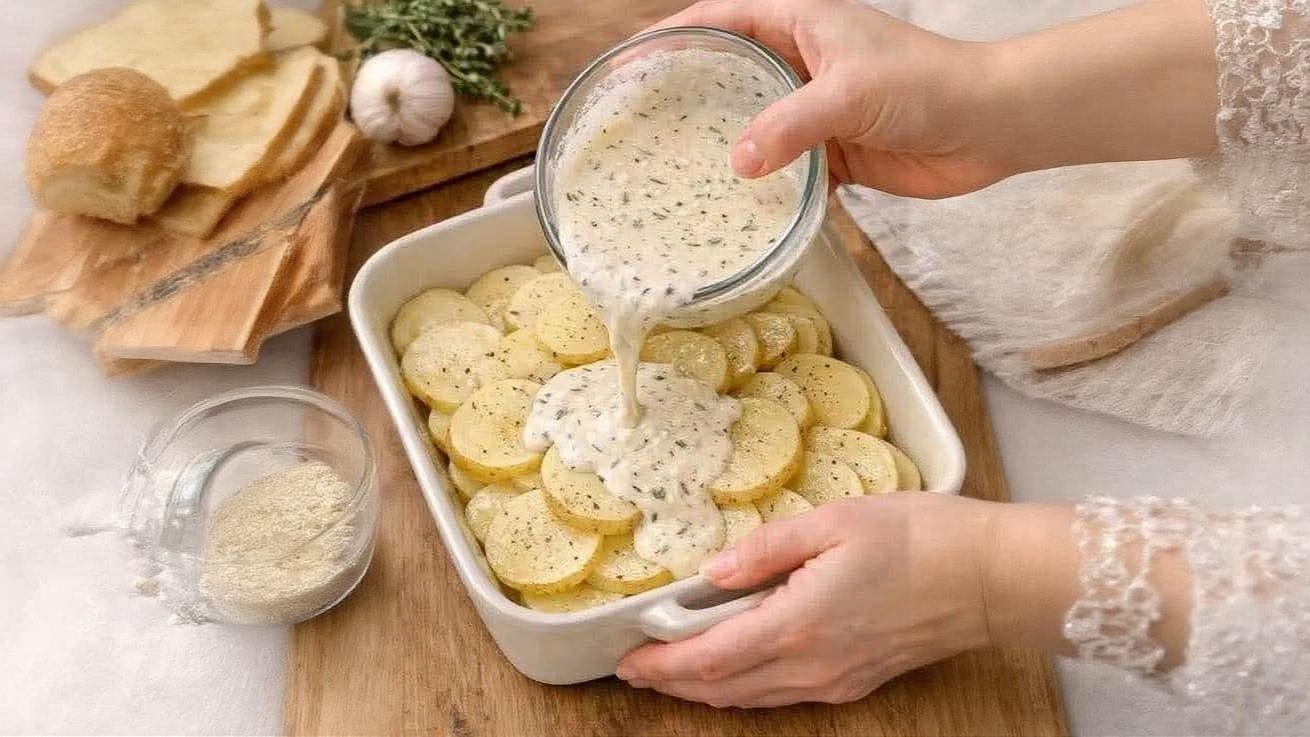
Golden Crusted Creamy Parmesan Oven Baked Potatoes
These Creamy Parmesan Oven Baked Potatoes redefine comfort food. We achieve a sublime textural contrast: a shatteringly crisp, deeply browned crust giving way to layers of potatoes suspended in an intensely savory, garlic-infused cream sauce thickened naturally by starch gelatinization. This is the side dish that elevates any American meal, proving that simple ingredients, treated with professional care, can achieve culinary magic right in your home oven.
restaurant_menu Ingredients
Potato and Dairy Base
Parmesan Crust & Garnish
hardware Essential Tools
9x13 inch baking dish (glass preferred)
Mandoline slicer or very sharp knife
Large mixing bowl
Whisk
Aluminum foil
Wire cooling rack
format_list_numbered Preparation
Preparation and Sauce Infusion
Preheat your oven to 375°F (190°C) and thoroughly butter the entirety of your 9x13 inch baking dish. Ensure all surfaces are coated to prevent sticking and promote even browning.
Layering and Initial Bake
Arrange half of the thinly sliced potatoes into an even, slightly overlapping layer in the prepared dish, then pour half of the cream mixture evenly over the top, gently pressing down to submerge the layers.
Finishing the Bake
Remove the aluminum foil and return the dish to the oven for an additional 25 to 30 minutes, watching closely until the edges are deeply browned and bubbling vigorously, and a fork slides through with no resistance.
favorite You Might Also Love
Browse All arrow_forward
Creamy Slow Cooker Herb Potatoes Recipe (Effortless Side Dish)

Crunchy Avocado Cucumber Salad Recipe (Fresh & Vibrant)
Cheesy Mixed Vegetable Bake Recipe (Creamy & Comforting)
Retro Cherry Fluff Salad: A Potluck Star

Air-Fried Crispy Parmesan Cauliflower: An Irresistible Recipe
Pineapple Casserole Recipe (Sweet & Savory Side)
Try These Variations
Herbaceous Shallot & Gruyère Variation
For a more French-inspired gratin, omit the dried thyme and instead sauté 2 finely minced shallots in the butter until translucent before adding the garlic. Replace 1 cup of the Parmesan with 1 cup of freshly grated Gruyère cheese, which melts into long, wonderful strands. Gruyère adds a wonderful nutty sweetness that complements the shallots beautifully, making this a fantastic pairing for holiday ham or roast turkey.
Spicy Smoked Paprika Kick
If you enjoy a little heat, incorporate 1 teaspoon of smoked paprika and ½ teaspoon of cayenne pepper directly into your cream mixture. The smoked paprika adds a wonderful depth that mimics slow-roasting notes, pairing exceptionally well if you are serving this alongside something like Kielbasa Soup With Potatoes or barbecue. Be cautious with the cayenne; you want warmth, not overwhelming fire, as it should complement the cheese, not conquer it.
Caramelized Onion Base
Before layering the first potato layer, spread a thin, even layer of deeply caramelized onions across the bottom of the buttered dish. Caramelizing onions properly takes 45 minutes of low-and-slow cooking, but the resulting sweetness provides an incredible counterpoint to the sharp saltiness of the Parmesan topping. This variation requires you to use slightly less salt in the cream mixture initially, as the onions concentrate flavor as they cook down.
Chef's Pro Tips
Temper Your Dairy Before Baking
Before pouring the cream mixture over the potatoes, let it sit on the counter for 15 minutes after you’ve mixed in the cheese and seasonings. This allows the cheese to begin dissolving slightly and the dairy to warm up just a touch. Introducing cold liquid to warm potatoes can shock the starch structure. By slightly tempering the liquid (bringing it closer to room temperature), the starch gelatinization process begins more evenly upon entering the oven, leading to a smoother, more homogenous sauce texture throughout the layers.
The Importance of Maldon Salt for Finishing
While kosher salt is essential for seasoning the internal cream sauce (its larger crystals dissolve well in liquid), finishing the dish with a sprinkle of flaky sea salt, like Maldon, right before serving is a game-changer. Flaky salt provides an immediate, bright burst of salinity and a delightful, almost sparkling texture on the tongue that contrasts with the softness underneath. It’s a textural garnish that hits the sensory receptors differently than salt dissolved into the sauce.
Use a Thin Layer of Butter Under the Foil
When you cover the dish with foil for the first bake, lightly brush the underside of the foil with a tiny bit of melted butter or spray it generously with non-stick cooking spray. This prevents the cheese or cream that rises during the steam phase from sticking to the aluminum. If the cheese sticks to the foil, it rips off when you remove the cover, ruining your perfect initial layer and leaving a patchy top for the final browning stage.
Storage Guide
Refrigerator Storage
Once cooled completely (this is essential to prevent condensation from turning the crust soggy), transfer the leftovers into a shallow, airtight glass container. Glass is preferable as it doesn’t absorb odors like plastic can. You can store them for up to 4 days. When reheating individual portions, place them in a small oven-safe dish, add one teaspoon of milk or broth per serving to reintroduce steam, cover tightly with foil, and bake at 325°F (160°C) for 15-20 minutes. The foil traps the steam, rehydrating the potato layers perfectly.
Freezer Instructions for Future Feasts
These potatoes freeze reasonably well, though the texture will be slightly softer upon thawing than when fresh. Cool the baked potatoes entirely, cut them into individual serving squares, and place them in a single layer on a parchment-lined baking sheet. Freeze until solid (about 2 hours). Once frozen solid, transfer the squares to heavy-duty freezer bags, pressing out as much air as possible. Label with the date; they keep well for up to 2 months. To reheat from frozen, place servings in a foil-covered casserole dish with an extra splash of cream, and bake at 300°F (150°C) for 45 to 60 minutes, checking for doneness.
Avoid These Mistakes
✕ Using Pre-Shredded Cheese
This is perhaps the most common error in any gratin or baked cheese dish. Pre-shredded Parmesan is coated with cellulose powder to prevent clumping in the bag. When heated, this powder doesn’t melt; it absorbs moisture and creates a grainy, chalky texture in your otherwise silky sauce. Furthermore, the anti-caking agents prevent the cheese from forming that beautiful, continuous, browned crust. Always grate your Parmesan from a block; the flavor payoff is immense, and the texture will be incomparably smoother and richer.
✕ Not Pressing the Layers Down
When assembling the layers, many cooks simply pour the liquid over the potatoes and assume gravity will do the rest. It won’t. The top layer of potatoes often floats slightly, leaving a dry, undercooked gap between the layers. After placing the second layer of potatoes and pouring the remaining cream, use a sturdy spatula or the back of a measuring cup to gently but firmly press the entire surface down until you see the cream mixture start to bubble up around the edges. This ensures full saturation and even cooking, which is vital for the final texture of your Creamy Parmesan Oven Baked Potatoes.
✕ Rushing the Final Browning
Many recipes suggest a quick broil for the last few minutes to achieve that deep golden color. While effective, this step requires constant vigilance. Parmesan cheese, due to its low moisture and high fat/protein content, browns extremely quickly—often in under 90 seconds. If you walk away to grab a drink or answer the phone, you will return to a burnt, acrid crust. Watch through the glass door; the moment the cheese achieves the deep mahogany color you desire, pull it out immediately. If you notice one area browning much faster, quickly shield it with a small piece of foil.
nutrition Nutrition Facts
Per serving: Approximately 1 cup serving
Nutritional information is an estimate based on standard ingredient formulations and serving size.
flag Conclusion
There you have it: the blueprint for achieving restaurant-grade comfort food in your own home. These Creamy Parmesan Oven Baked Potatoes are deeply satisfying, texturally complex, and utterly foolproof when you adhere to the principles of uniform slicing and gentle initial steaming. Don’t be intimidated by the ingredient list; it’s the technique that transforms these simple components into something truly memorable. Make this dish for your family this weekend, and watch as your guests ask for the recipe. We celebrate the joy of creating something this luxurious from scratch here at HomeRecipes.com. Now, go forth and bake brilliance!
sell Related Topics
Frequently Asked Questions
Why are my potatoes still hard after the covered baking time? expand_more
This almost always points to one of two culprits: uneven slicing or insufficient liquid absorption. If your slices were too thick—say, over 3/16 of an inch—the heat simply hasn't penetrated the center sufficiently. The other major factor is pressing the potatoes down before covering them. You must gently but firmly press the top layer down so that the cream mixture is truly in contact with all the potato surfaces. If they aren't submerged, they dry out and harden. Next time, use the mandoline religiously and ensure every slice is uniform, and press firmly before covering for that initial 35-minute steam at 375°F.
My cheese topping became oily and separated instead of browning nicely. What went wrong? expand_more
This is a classic case of using the wrong type of Parmesan or overheating the dairy too quickly. Pre-shredded cheeses contain cellulose, which inhibits smooth melting and causes the fat to separate prematurely, resulting in an oily slick. Secondly, if you go straight to broil without letting the potatoes soften first, the high heat scorches the proteins in the cheese before the dairy underneath has stabilized. Always use freshly grated cheese, and remember to bake covered first. If you want a richer brown, mix 1 tablespoon of Panko breadcrumbs with the reserved Parmesan before sprinkling; the breadcrumbs help absorb excess surface moisture and promote an even golden crust.
Can I make this dish ahead of time, perhaps the day before serving? expand_more
Absolutely, and I often encourage it! Making these Creamy Parmesan Oven Baked Potatoes a day ahead is a fantastic strategy for entertaining. The flavor profile deepens significantly overnight as the garlic and salt fully penetrate the potato layers. Assemble the entire dish—potatoes, cream mixture, and the top layer of cheese—but do not bake it. Cover it tightly with plastic wrap and refrigerate for up to 24 hours. When ready to bake, pull it out of the fridge about 45 minutes before you plan to put it in the oven to let it temper slightly, then proceed with the recipe, adding about 10-15 minutes to the covered baking time due to the cold starting temperature.
What type of potato is truly best for this recipe? expand_more
While this recipe works reasonably well with Russets, I strongly advocate for Yukon Golds or similar all-purpose, medium-starch potatoes like Yellow Finn or White Rose. These varieties strike the perfect balance: they have enough starch to thicken the cream sauce beautifully through gelatinization—creating that luxurious binder—but enough structural integrity to hold their distinct layered shape. Starchy potatoes like Russets, while excellent for mashing, can sometimes break down too much, yielding a texture closer to mashed potatoes rather than distinct, creamy layers when baked this way. The inherent buttery flavor of the Yukon Gold also complements the Parmesan beautifully.
Is there a way to lighten up this incredibly rich dish? expand_more
While I champion indulgence, I understand the desire for a slightly lighter option. To lighten these decadent Creamy Parmesan Oven Baked Potatoes, you can substitute half of the heavy cream with an equal amount of half-and-half. This reduces the fat content significantly while still providing enough richness. You must, however, compensate for the reduced structure by adding 1 tablespoon of all-purpose flour, whisked thoroughly into the cream and milk mixture along with the seasonings before pouring over the potatoes. This added starch mimics the binding power lost by removing some of the heavy cream fat, ensuring you still get that thick sauce, albeit slightly less luxurious.
More Recipes You'll Love

Cool Cucumber and Sour Cream Salad Recipe (Creamy & Fresh)

Kentucky Christmas Salad Recipe (Citrus Holiday Fruit)
Irish Colcannon Recipe (Creamy & Hearty)

Five-Ingredient Bacon Potato Casserole Magic
Oven Roasted Corn on the Cob Recipe (Buttery & Tender)

Community Kitchen