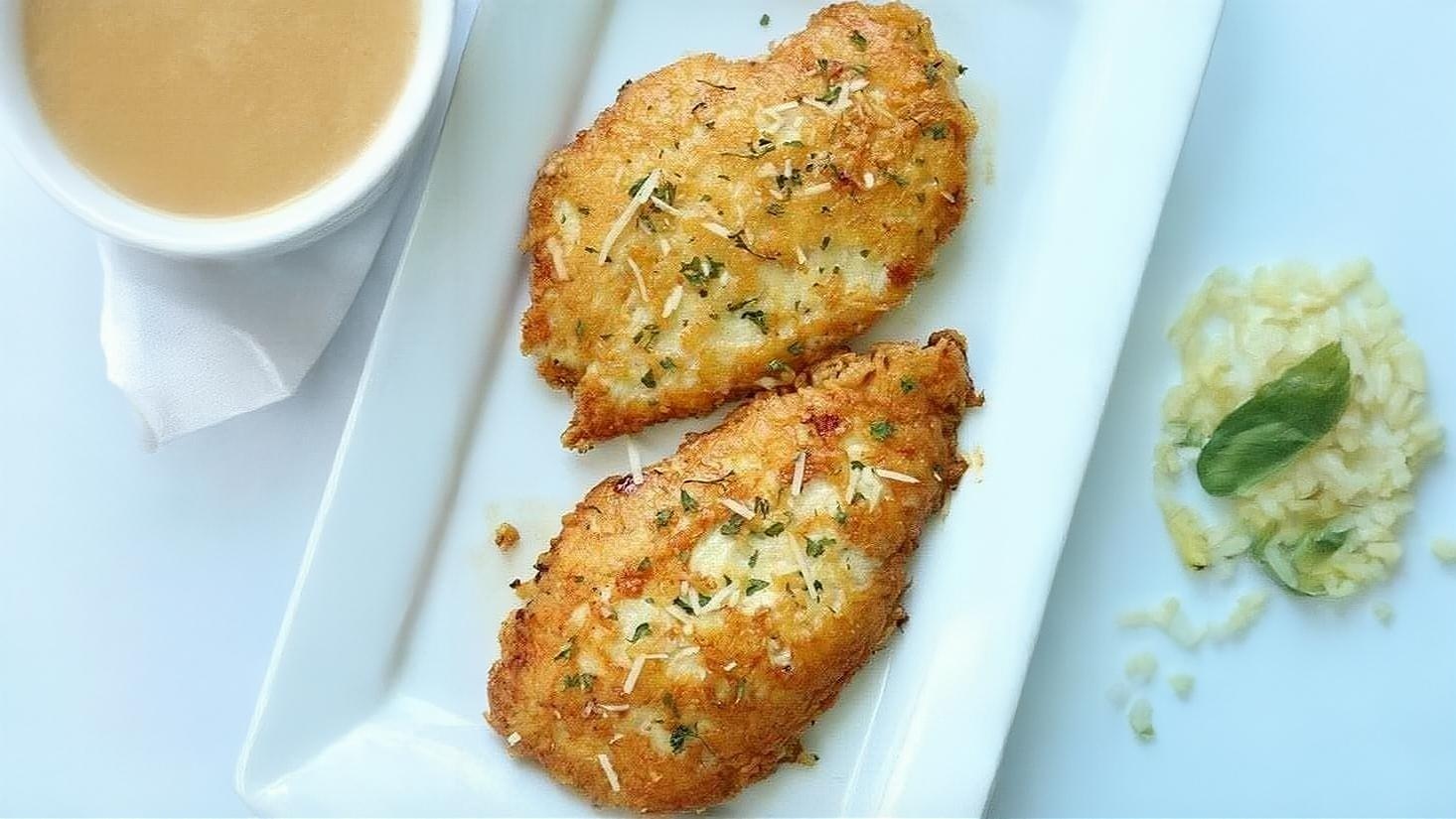
Restaurant-Quality Parmesan Crusted Chicken Cutlets
This isn't your grandmother's dry, bland chicken—this is perfectly engineered Parmesan Crusted Chicken. By using thin cutlets and a double-dredge technique, we create a crust that shatters on contact, locking in moisture. The blend of sharp Parmesan and savory spices creates a robust flavor profile perfect for a quick, impressive family dinner or a sophisticated luncheon entree. It’s comfort food refined by professional technique, making it a staple for any American home cook seeking quality without complication.
restaurant_menu Ingredients
For the Chicken Cutlets
For the Parmesan Crust
For Serving
hardware Essential Tools
Large cutting board
Sharp chef's knife
Meat mallet or rolling pin (for pounding)
Three shallow bowls (for dredging station)
Large stainless steel or cast-iron skillet
Tongs
Instant-read thermometer
format_list_numbered Preparation
Preparing the Chicken Cutlets
Start by preparing your chicken breasts; carefully slice each breast horizontally through the middle to create four thinner, uniform cutlets. This ensures even cooking, which is paramount for delicious Parmesan Crusted Chicken.Place the cutlets between two sheets of plastic wrap or inside a large zip-top bag. Using the flat side of a meat mallet, gently pound them from the center outwards until they are uniformly about 1/2-inch thick. This process tenderizes the meat and dramatically reduces cooking time, ensuring the crust doesn't burn before the center is done.Season both sides of the pounded chicken cutlets generously but evenly with kosher salt and freshly ground black pepper. Make sure your seasoning makes direct contact with the meat.
Assembling the Dredging Station
Set up your three-stage dredging station. In the first shallow bowl, place your two lightly beaten eggs. Whisk them just enough to break the yolks—we don't want too much air incorporated.In the second bowl, combine the 1 cup of finely grated Parmesan cheese, 3/4 cup of Italian breadcrumbs, garlic powder, onion powder, paprika, and optional oregano. Whisk this dry mixture thoroughly. The key here is homogeneity; every bite of your Parmesan Crusted Chicken must have the same flavor profile.The third bowl should be empty, ready to receive the perfectly coated cutlets.
favorite You Might Also Love
Browse All arrow_forward


Try These Variations
Spicy Southwest Parmesan Crusted Chicken
Replace the sweet paprika with smoked paprika and add 1 teaspoon of chipotle powder and 1/2 teaspoon of ground cumin to the breadcrumb mixture. For serving, skip the lemon and instead substitute the creamy sauce with a dollop of fresh avocado crema or a simple salsa verde. This variation brings a wonderful smoky depth that complements the salty cheese beautifully, transforming the classic Parmesan Crusted Chicken into something vibrant and exciting.
Herb-Forward Mediterranean Variation
Instead of standard Italian breadcrumbs, use Panko breadcrumbs mixed with 1/4 cup of finely chopped fresh herbs: 2 tablespoons fresh rosemary and 2 tablespoons fresh sage. Reduce the dried spices slightly and increase the salt. Once cooked, finish the Parmesan Crusted Chicken by setting it under the broiler for 60 seconds with a thin slice of Provolone cheese melted on top. The sharp, pungent flavor of the fresh herbs cuts through the richness of the cheese and oil perfectly.
Gluten-Free Crispy Crust
For those needing a gluten-free option, substitute the Italian breadcrumbs with an equal amount of high-quality gluten-free breadcrumbs or finely crushed rice crackers for texture. Ensure your grated Parmesan cheese is certified gluten-free (most are, but always check labels). The technique remains identical, but remember that GF coatings tend to brown slightly faster, so monitor the heat closely when pan-frying your Parmesan Crusted Chicken to prevent premature burning.
Oven-Baked ‘Healthier’ Parmesan Crusted Chicken
For a lighter take, skip the pan-frying entirely. After coating, lightly spray both sides of the cutlets with cooking spray. Bake on a parchment-lined sheet at 400°F (200°C) for 18-20 minutes, flipping halfway through. While the pan-fried version offers superior crust texture due to direct fat contact, this method achieves about 90% of the crispness with significantly less added fat, making it excellent for weekly meal prep.
Chef's Pro Tips
The secret to an authentic, deeply savory crust on your Parmesan Crusted Chicken lies in the cheese itself. If you use high-quality, freshly grated Parmigiano-Reggiano, you get wonderful flavor, but it can sometimes contain too much moisture or oil, leading to a slick, less crunchy coating. For the best textural result, I often recommend using a blend: 3/4 cup of freshly grated Parmigiano for flavor, and 1/4 cup of finely ground, shelf-stable, pre-grated Parmesan (the kind you find in the green shaker can) for its superior binding and drying properties. This hybrid approach gives you the best of both worlds—deep flavor and an unbeatable crunch.
Always pound your chicken evenly. I cannot stress this enough. If you have thick spots and thin spots, the thin spots will burn while the thick spots remain raw or undercooked. Use plastic wrap to protect the meat from tearing, and work from the center outward with gentle, consistent pressure until the entire cutlet is the same thickness, preferably 1/2 inch. This consistency is the foundation of professional cooking, ensuring every piece of Parmesan Crusted Chicken cooks perfectly in the same amount of time.
Never skip the resting period. After removing the chicken from the hot skillet, place it on a wire rack, not paper towels. Paper towels trap steam, which immediately begins to soften the beautiful crust you worked so hard to create. Allowing the hot chicken to rest on a rack permits air circulation underneath, keeping the bottom crispy while the internal temperature stabilizes and the muscle fibers relax, resulting in significantly juicier meat.
When searing, use a large skillet, even if you are only cooking two cutlets. You need ample space between the pieces. If the cutlets are touching, they release steam into the confined area between them, which prevents the Maillard reaction from occurring properly on the sides, resulting in soft, pale streaks instead of the desired all-over golden crust on your Parmesan Crusted Chicken. Think of the skillet as a stage: give every actor (the chicken) enough room to perform!
Storage Guide
For optimal texture preservation, the best method for storing leftover Parmesan Crusted Chicken is on a wire rack set over a baking sheet, loosely covered with plastic wrap, and stored in the refrigerator for up to 3 days. Storing it directly on a plate or tightly sealed in a container traps condensation against the crust, leading to immediate sogginess. The rack allows ambient air circulation to keep the bottom crust as dry as possible, although some minor softening of the top crust is inevitable.
If you plan to freeze leftovers, freeze them *uncovered* on a baking sheet until solid (this is called flash freezing). Once solid, transfer the cutlets to a heavy-duty freezer bag, squeezing out all excess air, or vacuum seal them. This prevents the breading from sticking to itself or absorbing freezer odors. They will keep well for up to 2 months. Ensure you place parchment paper between layers if you stack them after flash freezing to prevent sticking.
Reheating is crucial to reviving the texture. The microwave is strongly discouraged as it steams the crust, turning it rubbery. For the best results, reheat the Parmesan Crusted Chicken in a preheated oven at 375°F (190°C). Place the cutlets directly on a wire rack set over a baking sheet (this mimics the frying environment) and bake for 10 to 12 minutes, or until the internal temperature reaches 165°F (74°C). If the crust needs extra crisping, finish under the broiler for the last 60 seconds, watching constantly to prevent the Parmesan from burning.
Avoid These Mistakes
✕ Overcrowding the skillet is the number one killer of crispy coatings. When you place too many pieces of Parmesan Crusted Chicken into the pan at once, the temperature of the cooking fat drops dramatically. Instead of searing and frying the breading instantly, the lower temperature causes the moisture trapped in the egg wash and breadcrumbs to steam out, resulting in a pale, soggy, or oily crust that never achieves that satisfying golden-brown shatter. Always work in batches, ensuring the oil returns to a perfect shimmer between each batch.
✕ Using the wrong fat or pan temperature is another critical error. If your oil is too cool, the breading soaks up excessive amounts of fat before it has a chance to crisp, leading to greasy chicken. If it’s smoking hot, the breading will burn instantly while the interior remains raw. For this recipe, aim for medium heat, around 325°F to 350°F, ensuring the fat shimmers but does not smoke aggressively. A cast-iron skillet holds heat beautifully, providing the most consistent temperature control for this type of pan-fried preparation.
✕ Not pressing the coating firmly enough onto the chicken is a common oversight, especially when using fresh, wetter Parmesan. The egg wash acts as the adhesive, but it requires physical persuasion to stick properly. After dipping the cutlet in the breading mixture, use the flat of your hand to gently but firmly press the mixture into the surface of the chicken. This mechanical action forces the breadcrumbs and cheese into the egg matrix, creating a cohesive crust that stays put during the aggressive environment of the hot skillet, ensuring your Parmesan Crusted Chicken remains perfectly coated.
✕ Failing to dry the chicken first guarantees a weak crust. Chicken breast naturally holds surface moisture. If you dredge wet chicken, the water molecules immediately interfere with the adhesion of the egg wash, creating a slick layer between the meat and the breading. Before seasoning, use paper towels to blot every surface of the chicken until it feels dry to the touch. This dry surface is essential for creating the strong bond needed for a durable, crispy crust on your Parmesan Crusted Chicken.
nutrition Nutrition Facts
Per serving: 1 cutlet
This calculation is based on using standard olive oil and shelf-stable Parmesan. Using less oil or leaner chicken will reduce the fat content.
flag Conclusion
There you have it—the definitive guide to creating Parmesan Crusted Chicken that rivals any downtown bistro. This dish proves that incredible flavor doesn’t require hours of labor or obscure ingredients; it requires attention to detail and a respect for technique. From pounding the cutlets evenly to understanding the science of the dredging station, every step is designed to deliver that perfect, audible crunch every time you slice into your meal. I encourage you to make this your go-to weeknight hero. Don’t be afraid to experiment with the herbs or spices in the crust, but always honor the foundation we built here. Serve it proudly, and enjoy the applause your cooking deserves. Happy cooking from my kitchen to yours!
Frequently Asked Questions
Why does my Parmesan Crusted Chicken crust keep falling off during cooking? expand_more
This almost always relates to adhesion failure during the dredging process. Firstly, ensure your chicken is completely patted dry before seasoning; surface moisture is the enemy of adhesion. Secondly, ensure your egg wash is fully coating the meat, and thirdly, and most critically, you must press the breadcrumb/cheese mixture firmly onto the egg-coated chicken. Don't just roll it; use the flat of your hand to physically embed the crust into the egg matrix. If the coating is loose, the turbulence of the hot oil will easily peel it away. Also, make sure your oil is hot enough (shimmering) before the chicken goes in; a cool pan allows the coating to soak up oil before it sets.
Can I substitute the chicken breasts with thighs or use pre-cut cutlets? expand_more
You absolutely can substitute boneless, skinless chicken thighs, but you must adjust your cooking time significantly. Thigh meat has more fat and connective tissue, meaning it requires a longer, slower cook to become tender. If using thighs, I recommend pan-frying them for 6-7 minutes per side over medium-low heat, or until they reach an internal temperature of 175°F (80°C) for optimal texture, rather than the standard 165°F for breast meat. If you use pre-cut, thin cutlets, you may need to reduce the cooking time by a minute per side, as they will be thinner than the 1/2-inch thickness we aim for.
What is the best type of Parmesan cheese to use for maximum crispiness? expand_more
This is an insider secret! While fresh Parmigiano-Reggiano tastes superior, the highest quality fresh cheeses have more moisture and oil content, which can sometimes lead to a slightly softer crust when pan-fried. For the absolute crispiest, most stable crust on your Parmesan Crusted Chicken, I advocate for a 75/25 blend: use 75% of your required amount as the high-quality fresh cheese for flavor, and 25% as the shelf-stable, finely ground variety (like the Kraft brand). The dried, powdered stabilizers in the shelf-stable cheese act as a superior binder and drying agent, locking in that perfect crispness during the sear.
My chicken is cooked through, but the crust is still pale. What went wrong? expand_more
If the chicken reaches 165°F internally but the crust remains pale, the cooking fat was not hot enough, or you used too much fat. If the fat is too cool, the breading absorbs the oil instead of crisping via rapid dehydration. The solution is simple: turn the heat up to medium-high for the final 1-2 minutes of cooking on each side, allowing that final burst of heat to promote browning via the Maillard reaction on the breadcrumbs and cheese. Watch carefully during this stage to prevent burning.
Can I prepare the coating mixture and the chicken ahead of time for faster dinner prep? expand_more
You can certainly prepare the dry coating mixture up to three days in advance; store it sealed in an airtight container at room temperature. However, I strongly advise against coating the chicken cutlets more than 30 minutes before cooking. Coating too early allows the moisture in the egg wash to migrate into the breadcrumbs, causing them to become paste-like and lose their crisp structure. If you must prep ahead, coat the cutlets, place them on a wire rack over a tray, and refrigerate uncovered for up to 2 hours. This keeps the crust relatively dry before it hits the hot pan.
More Recipes You'll Love
Layered Comfort: The Ultimate Ravioli Lasagna Recipe
Creamy Baked Poor Man’s Steak: 4-Ingredient Comfort
Velvet Crockpot Mac And Cheese Mastery
Paprika Steak Shells Recipe (Hearty Stuffed Pasta)
Ultimate Pizza Burgers: A Diner Classic Reimagined
Community Kitchen