
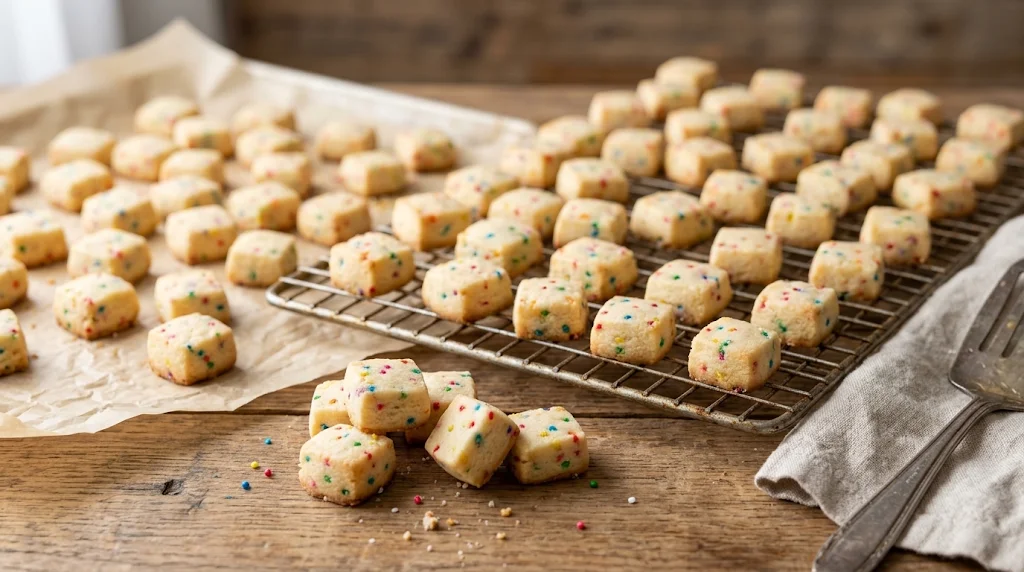
Chill the rolled dough for the full 25 minutes and keep the uncut part cold while you bake, because firm butter is what lets a knife make clean cubes that hold their edges in the oven. That’s how Tidbit Cookies, small almond shortbread bites studded with rainbow sprinkles, stay neat and pale.
The dough takes five ingredients and about 10 minutes to mix, then 25 minutes in the refrigerator and 8 to 10 minutes in the oven for each tray. It’s an easy project that’s mostly waiting. The recipe card lists a yield of 24 cookies, so plan on a batch for a party tray or a gift box. Use salted butter, since it’s the only salt in the dough, and cut with a sharp, thin knife so the sides of the cubes stay straight and the sprinkles don’t drag.
Planning Around the Chill and the Batches
Think of the 45 minutes or so as three blocks. Mixing takes about 10 minutes, the dough chills for 25, and the baking runs in rounds of 8 to 10 minutes. Heat the oven after the dough comes out of the refrigerator, as the recipe does, and use the chill time to clear your cutting board and set out ungreased baking sheets.
Plan for more batches than you’d expect. The card says 24 cookies, but half-inch cubes cut from this much dough add up to far more. By rough arithmetic, the dough rolls into a square about 8 to 9 inches across at 1/2 inch thick, which gives a few hundred tiny cubes. Cut one strip at a time, bake those, and leave the rest of the square cold.
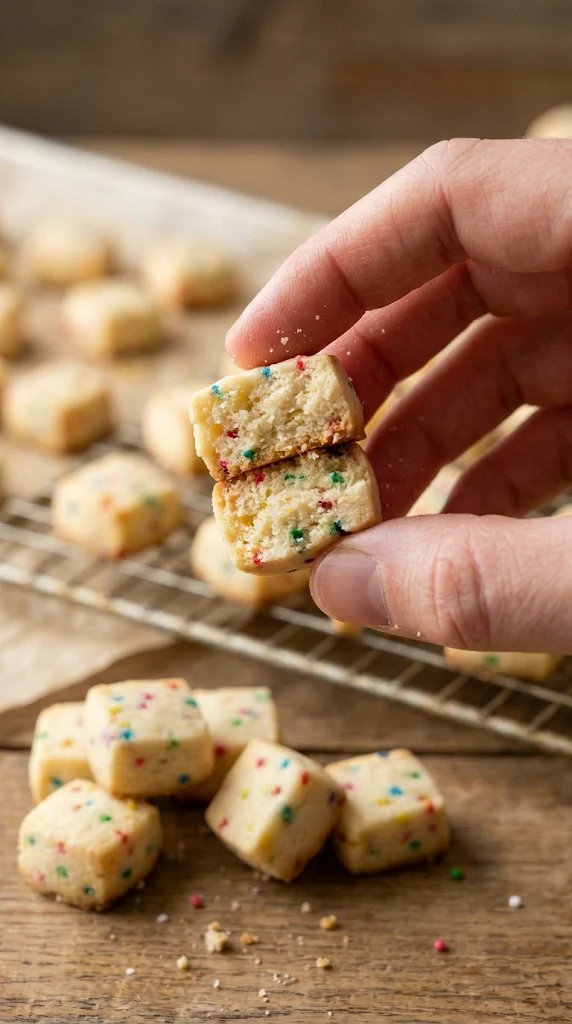
Judge the chill by touch. The dough is ready to cut when it feels firm, like cold butter, and the knife glides through without sticking. If it dents easily or smears, give it another 10 minutes. Judge the bake by eye. Only the edges should show a first pale gold, while the tops stay light. The cookies feel soft when they come out and firm up as they cool.
Crumbly, Greasy or Spread Out
- The dough is crumbly and won’t come together. The butter was too cold to blend, or the flour went in too fast. Let the bowl stand for a few minutes at room temperature, then mix gently until the dough holds together when pressed.
- The dough is soft and sticky. The butter has warmed too much. Chill the dough in the bowl for 10 minutes before you roll it.
- The cubes spread into flat rounds. The dough warmed up while you cut. Put the tray in the refrigerator for 5 to 10 minutes before baking, and keep the uncut dough chilled.
- The cookies brown before the centers set. The oven runs hot. Check it with an oven thermometer, and start looking at 8 minutes for the first golden edges.
- The cookies are tough. The dough was overmixed after the flour went in. Stop mixing as soon as no dry flour shows.
- The cubes are uneven. The dough wasn’t rolled to the same thickness all over. Roll from the center out and check the edges against a ruler.
- The sprinkle colors bleed. Some sprinkles run in the heat. Use nonpareils labeled for baking.
Cold Dough and a Light Hand
A shortbread-style dough is mostly butter, sugar and flour, so nearly all of the texture comes from how the butter behaves. Chilled butter is firm and holds its shape, which lets a knife cut straight down instead of smearing the dough. In the oven the butter melts gradually, so the cubes keep their edges long enough for the flour to set around them.
Gluten is the other half. Flour forms gluten when it’s wet and worked, and the butter coats the flour and limits it, but a long mix undoes that. That’s why the flour goes in slowly and the mixing stops when no dry flour shows. The cookies stay short and tender instead of tough. Shortbread follows the same logic, with a high proportion of butter to flour.
A pale bake finishes the job. Pulling the tray when only the edges turn golden stops the sugar from browning the centers and drying the crumb. Because the cubes are small, they go from pale to dark fast, so stay near the oven from about 8 minutes.
Salted Butter and Other Swaps
The salted butter is the only salt in the dough, so it’s the main seasoning, not just a detail. Almond extract is strong, so measure it exactly, and pure extract gives a more noticeable almond flavor than imitation. Nonpareils are tiny round sprinkles, and they hold their color and shape through baking better than long, thin ones.
| Ingredient | Swap | What changes |
|---|---|---|
| Salted butter | Unsalted butter plus 1/4 tsp fine salt | Same flavor, and you control the saltiness |
| Almond extract | Vanilla extract, 1/2 tsp | A plainer, more familiar flavor |
| Rainbow nonpareils | Pastel or holiday nonpareils | Same quantity, different colors |
| All-purpose flour | 1-to-1 gluten-free baking blend | Sandier, more fragile cookies |
| Salted butter | Plant-based butter sticks | Dairy-free, but the dough is softer and needs longer chilling |
As written, the cookies contain wheat and milk. Almond extract is a flavoring and not whole almonds, but it’s made from almond, so read the label if anyone has a tree nut allergy. Check labels on sprinkles and any gluten-free blend too, since both can contain other allergens.
Keeping Dough and Baked Cookies
The rolled square can wait in the refrigerator, wrapped well in the parchment, for up to 2 days before you cut and bake it. It can also be frozen, wrapped tightly, for up to 2 months. Thaw it in the refrigerator overnight and cut it once it’s firm but not rock hard.
The dough contains raw flour, which isn’t meant to be eaten uncooked. Flour comes from a raw crop and can carry germs that only baking kills, a point covered in the food safety guidance for raw dough. Wait to taste until the cookies are baked.
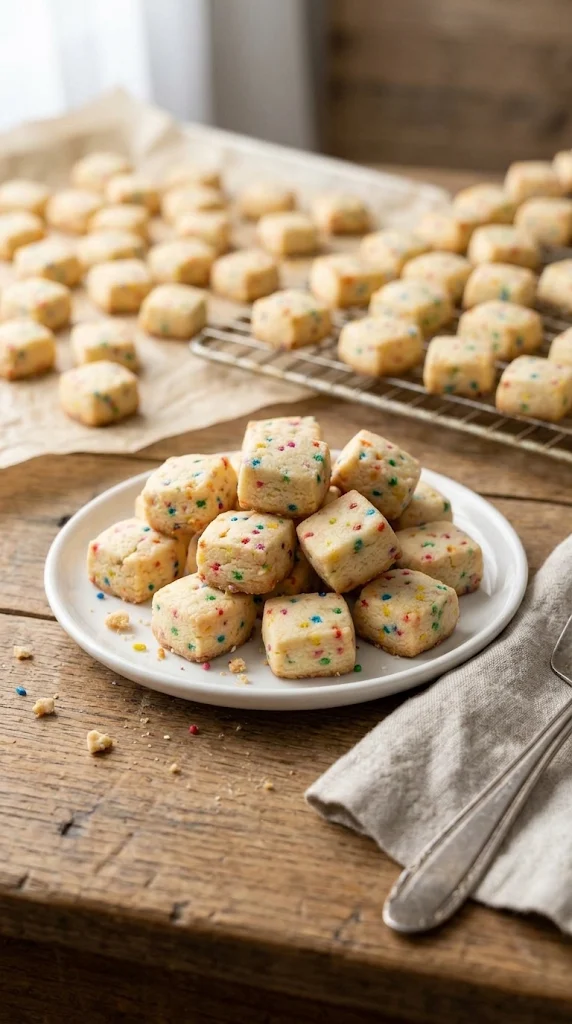
Let the baked cookies cool completely before storing, since trapped steam softens them. Keep them in an airtight container at cool room temperature, away from heat and humidity, for up to 5 days. A sheet of parchment between layers stops the sprinkles from sticking.
Baked cookies can also be frozen in a sealed container for up to 2 months. Thaw them in the closed container at room temperature so condensation forms on the container and not on the cookies. If they’ve gone soft, a few minutes on a tray in a 300°F (150°C) oven brings the crispness back.
Vanilla, Chocolate and Other Twists
These are common ways to change the cookies, and each one is a small adjustment to the dough or the finish.
- Vanilla instead of almond. Use 1/2 teaspoon of vanilla extract. The flavor turns plainer and more familiar, and the method stays the same.
- Chocolate in the dough. Replace about half of the sprinkles with finely chopped chocolate, about 2 tablespoons. The pieces melt a little in the oven, so the cubes look less colorful.
- Dipped cookies. Melt chocolate or white chocolate, dip one end of each cooled cookie and set them on parchment until the coating is firm, about 20 minutes. Check the chocolate label for allergens.
- Holiday colors. Use red and green or pastel nonpareils in the same quantity for a seasonal tray. Colors can bleed a little if the dough is warm, so keep it chilled and cut it just before baking.
Any change to the flavorings alters the taste and may change the allergen profile, so check labels if you’re baking for someone with an allergy.
Cookie Trays and Pairings
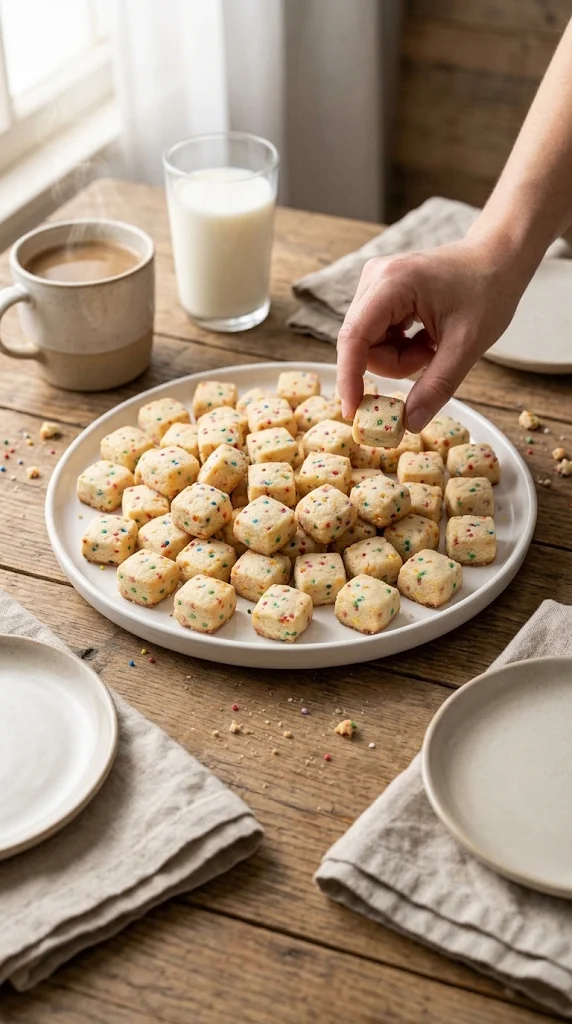
These small cookies suit a cookie tray, a jar on the counter or a gift box. Because they’re pale, buttery and crisp-tender, they look their strongest next to darker, chewier cookies. The soft brown sugar cookies make a good contrast, and the Berger cookies add a chocolate option.
For a party platter, the retro bakery dirt ball cookies sit well alongside these. Coffee, tea or a glass of cold milk goes with all of them. For a gift box, line it with parchment paper and pack the cookies in layers with sheets of parchment between them, so the sprinkles don’t rub off. Pack the sturdy, flat cookies at the bottom and keep any dipped ones in a separate layer, so the chocolate doesn’t smear on the others.
Serve them at room temperature. Cold from the refrigerator, the butter tastes muted, and a few minutes on the counter brings the almond flavor back.
If you’re serving a mixed tray, put the small cubes in a bowl or a shallow dish instead of spreading them across the platter. They’re easy to pick up by the handful, and the loose pile keeps the sprinkles from catching on the darker cookies. Refill the dish from a sealed container as it empties, so the rest stay crisp.
FAQ
Do tidbit cookies have almonds in them?
No, there are no whole almonds. The almond flavor comes from 1/2 teaspoon of almond extract. Because the extract is made from almond, people with a tree nut allergy should read the label or skip it. Vanilla extract is the easiest replacement if you want a plainer cookie.
Why are my cookies so pale?
They're meant to be. The recipe says to pull the tray when the edges just begin to turn golden, which keeps the centers soft and buttery. If the cookies feel doughy in the middle, bake them a minute longer. If they've gone brown all over, they baked too long or the oven runs hot.
Do I have to use parchment paper for rolling?
Parchment is the simplest option. It keeps the dough from sticking to the cutting board, and you can slide the whole square onto a tray to chill. You can roll between two sheets of it. Wax paper also works for rolling and chilling but shouldn't go in the oven.
Can I mix the dough by hand?
Yes, but the butter is chilled, so it takes effort. Let the cubes stand for 10 minutes first so they soften slightly, then mash them with the sugar using a sturdy spatula until smooth. An electric mixer is faster and blends the butter and sugar more evenly, so it's worth using if you have one.
Can I double the recipe?
Yes. Mix two batches in a large bowl or mix them separately, then roll the dough into two squares. Chill both, but bake one at a time and keep the other in the refrigerator. A double batch makes far more cubes, so plan on baking in many rounds.
Can I cut larger pieces than half an inch?
Yes. Larger pieces make bigger cookies, and they need a little more time in the oven. Keep an eye on the edges and pull the tray when they just turn golden, not by the clock. Space bigger pieces a little further apart, since they spread more than the small cubes.
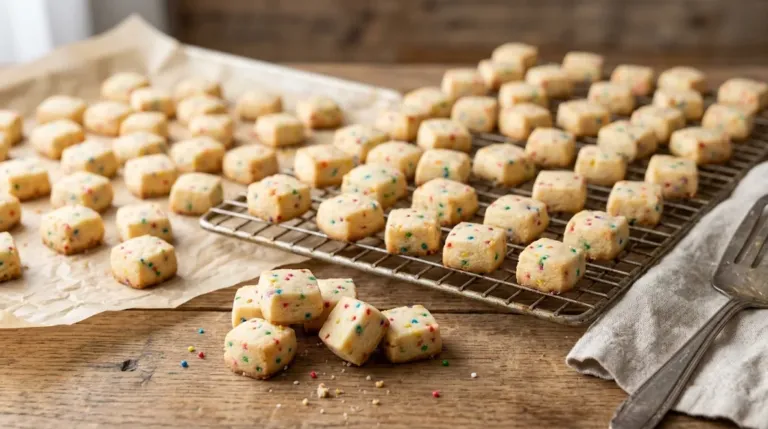
Tidbit Cookies Cut from Chilled Almond Shortbread Dough
- Prep 10 min
- Cook 10 min
- Total 20 min
Cook mode: your screen stays on and the current step is shown larger.
Ingredients
Steps
- Step 1 of 8
Cream the butter and sugar together in a large bowl until fully incorporated, with no streaks of sugar showing, then add the almond extract and mix until combined.
- Step 2 of 8
Add the flour slowly, mixing until just combined and no dry flour is left.
- Step 3 of 8
Mix in the sprinkles until they’re evenly spread through the dough.
- Step 4 of 8
Lay a large sheet of parchment paper over a cutting board and roll the dough into a square about 1/2 inch (1.25 cm) thick. Refrigerate for 25 minutes, until the dough feels firm.
- Step 5 of 8
Heat the oven to 350°F (175°C).
- Step 6 of 8
Cut the dough with a sharp knife into 1/2-inch (1.25 cm) cubes and arrange them on an ungreased baking sheet. Return the rest of the dough to the refrigerator until you’re ready to bake it.
- Step 7 of 8
Bake for 8 to 10 minutes, until the edges just begin to turn golden.
- Step 8 of 8
Cool the cookies completely, then store them in an airtight container.
Nutrition
- Calories
- 140 kcal
- Protein
- 1 g
- Fat
- 8 g
- Carbohydrates
- 16 g
- Sugar
- 7 g
- Fiber
- 0 g
- Salt
- 0.2 g
Approximate values per serving.
How did it turn out?
Related searches