
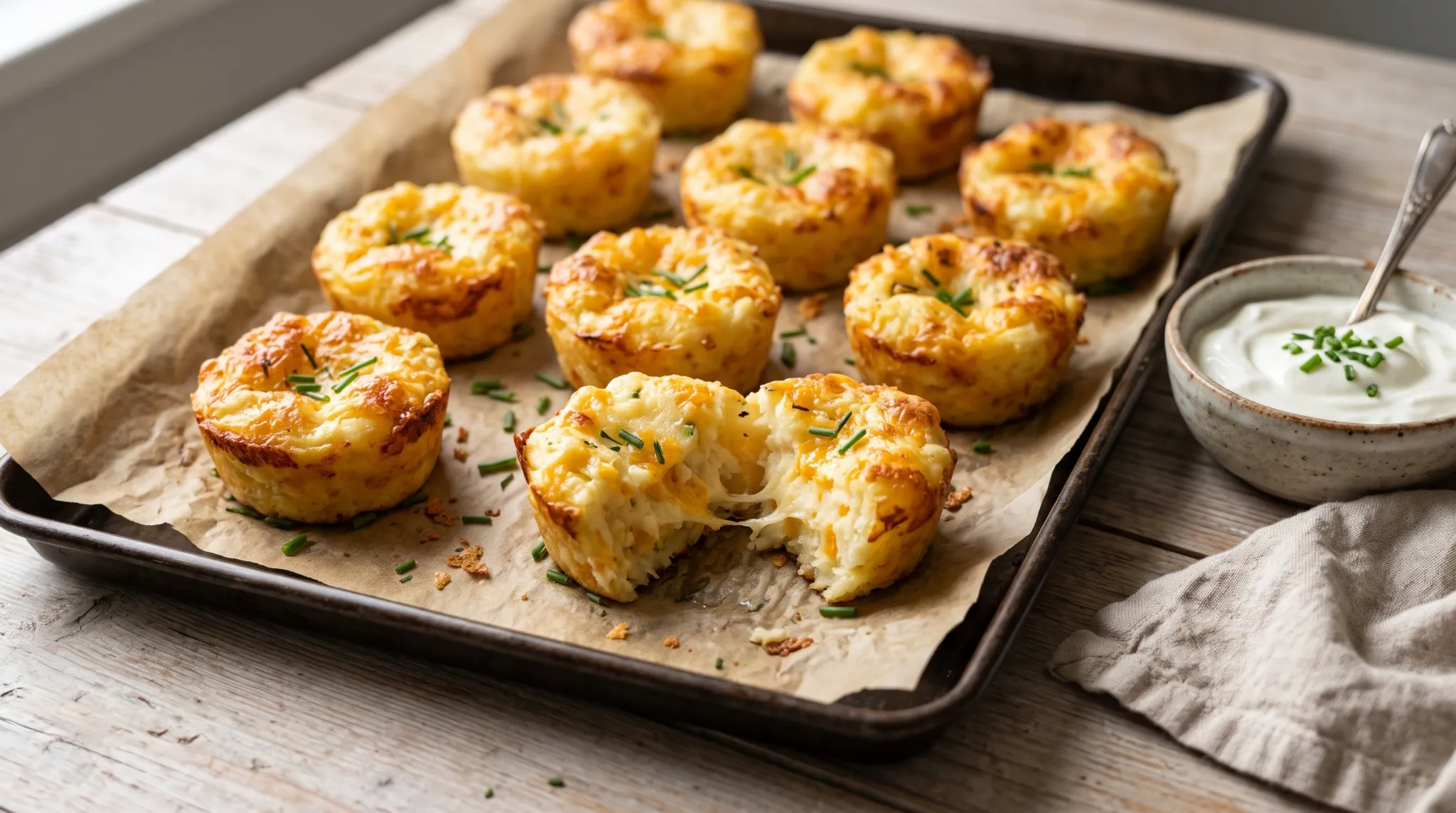
Holiday dinners, game-day spreads, and ordinary Sunday roasts all have room for a tray of cheesy mashed potato puffs, a mashed potato side you can eat with your fingers. This batch makes 16 puffs to serve 4, takes about 2 hours from peeling to table, and requires only about 40 minutes of hands-on work. The difficulty is easy, though two stretches of waiting decide how well the puffs hold together.
Boil russets, mash them with cheddar, an egg, and a little seasoning, chill until firm, then roll in panko tossed with melted butter. That butter is what lets the crumbs brown in the oven without any frying. The result is a crisp, golden shell around a soft, cheesy middle, and everything bakes on one sheet pan.
Timing the Cooling, Chilling and Baking
Start the potatoes first and use the simmering time to shred the cheese, slice the chives and line a baking sheet. The potatoes are ready when a knife slides in with no resistance and the edges of a chunk look slightly frayed. After draining, the pot goes back over low heat for a minute or two. You will see the steam thin out and a pale, floury film form on the potatoes, which means the surface water is gone.
Spread the mash on a rimmed sheet to cool. Wait until it stops steaming and feels barely warm to the back of your hand, usually 10 to 15 minutes, because hot mash starts cooking the egg and softens the cheese too soon. After folding everything together, the mixture should look thick and slightly tacky, like a stiff dough. If it still slumps off the spatula, give it the full 30 minutes in the refrigerator before you try to shape anything.
While it chills, melt the butter and toss it with the panko until the crumbs look like damp sand. In the oven the crumbs turn from pale to deep gold and smell toasty. If the tops are dark well before the 20-minute mark, move the pan down a rack.
Why Do My Puffs Spread, Crack or Turn Gummy?
Most failures trace back to moisture, temperature or handling, and each one has a quick fix.
- The puffs slump or spread on the pan. The mash was too wet or too warm when you shaped it. Steam-dry the potatoes after draining, cool the mash fully and chill the mixture for the full 30 minutes. If it still sticks to your hands, fold in 2 tablespoons of panko.
- The centers feel gluey. You likely overworked the potatoes, usually in a food processor or with a hand mixer, which ruptures the starch granules. Use a masher or ricer and stop as soon as the lumps are gone.
- The crumbs stay pale. The panko went on dry, or the pan sat too low in the oven. Toss the crumbs with the melted butter first and bake on the upper rack.
- Cheese leaks onto the pan. The shreds were in large clumps near the surface, or the oven was not fully hot, so the cheese melted before the shell set. Fold the cheese in evenly and wait until the oven reaches 400°F (200°C) before the pan goes in.
- The puffs taste flat. Potatoes only take up salt while they cook, and the cheese cannot season a whole batch on its own. Salt the cooking water and use a sharp cheddar.
- The insides are dry and crumbly. The puffs baked well past 28 minutes. Pull them as soon as the shells are deep gold and a center reads 160°F (71°C).
Why Steam-Dried Russets and Buttered Panko Work
Russets are high in starch and low in water, so boiled chunks break into dry, fluffy crumbs instead of a paste. Letting them sit in the hot, empty pot for a minute or two drives off the last surface moisture. Less water in the mashed potatoes means you need less egg and breadcrumbs to firm them up, and the cheese flavor stays concentrated.
Chilling does the structural work. Butter and cheese fat firm up in the refrigerator and the starch sets slightly, so a scoop rolls into a ball that keeps its shape as the oven heats. The egg then coagulates during baking and locks that shape in place.
The coating relies on a different trick. Panko flakes are dry and airy, but oven heat alone leaves them pale and dusty. Tossing them with melted butter coats every flake in fat, which carries heat across its surface and lets it brown through the same reactions that color a fried crust. You get a crunchy shell without a pot of hot oil.
Choosing the Potatoes, Cheese and Breadcrumbs
Pick russets, also sold as Idaho potatoes. Their mealy texture is what makes the mash light and dry enough to shape. Yukon Golds work if that is what you have, but they hold more moisture, so the puffs come out denser and creamier and may need a tablespoon or two of extra panko.
For the cheese, buy a block of sharp cheddar and shred it yourself. Bagged shreds are coated with starch to keep them loose, which can make them melt less smoothly. White and yellow cheddar behave the same way, and the color is the main difference, as the comparison of white and yellow cheddar explains. The puffs contain egg, milk and wheat, so check these swaps:
| Ingredient | Swap | What changes |
|---|---|---|
| Sharp cheddar | Gruyère or Monterey Jack, same weight | Gruyère is nuttier and Monterey Jack is milder and meltier |
| Panko | Plain dry breadcrumbs, ¾ cup (80 g) | Finer, denser crust that browns faster, so check at 20 minutes |
| Panko | Certified gluten-free panko, same amount | Gluten-free only if the spice and cheese labels are checked too |
| Egg | Potato starch, 2 tbsp (16 g) | Softer, more fragile puffs, so chill for 45 minutes |
| Butter and cheese | Plant-based butter and dairy-free shreds | Dairy-free if labels confirm it, with less richness and paler browning |
Making Ahead, Freezing and Reheating
Store the shaped, coated puffs on a tray, loosely covered, in the refrigerator for up to 24 hours. Bake them straight from the refrigerator, adding 3 to 5 minutes to the time.
For the freezer, set the coated, unbaked puffs on a tray for about 1 hour until solid, then move them to a freezer bag for up to 2 months. Bake from frozen at 400°F (200°C) for 32 to 38 minutes, until the shells are deep gold and the centers reach 160°F (71°C). Baked puffs freeze less well because the shell softens as they thaw.
Cooked puffs should reach the refrigerator within 2 hours of leaving the oven and keep for 3 to 4 days in an airtight container, per USDA Food Safety and Inspection Service guidance on leftovers. Reheat on a rack set over a baking sheet at 375°F (190°C) for 10 to 12 minutes, or in an air fryer at 350°F (175°C) for 6 to 8 minutes, until a center reads 165°F (74°C). The microwave heats them through but leaves the shell soft, so save it for times when crunch does not matter.
Bacon, Jalapeño and Other Add-Ins
Fold any of these into the mixture along with the cheese. Keep the add-ins dry, since extra moisture loosens the mash.
- Bacon. Cook 4 slices until crisp, drain on paper towels, crumble and add about ⅓ cup (35 g). The puffs taste smokier and saltier, so cut the salt in the mixture to ¼ tsp.
- Jalapeño. Add 1 seeded, finely minced fresh jalapeño or 2 tbsp (20 g) of pickled jalapeños patted dry. Leave the seeds in for more heat.
- Stuffed centers. Press a ½-inch (1 cm) cube of cheddar into each ball and close the mash around it before coating. The baking time stays the same, and the middle turns molten.
- Smoky. Stir ½ tsp smoked paprika into the panko. It adds color and a campfire note without any heat.
If you would rather skip the rolling, the cheesy potato stacks baked in a muffin tin give you cheesy potatoes in a different shape.
What to Serve Alongside
Four puffs per person makes a generous side, and two each works as a party snack for eight. Let them rest 5 minutes after baking so the cheese sets enough to hold together when bitten, and serve within about 15 minutes while the shells are still crisp.
They suit any plate that would normally have mashed potatoes. A roast chicken is the natural partner, with the puffs standing in for the mash. Grilled steak or sausages also work, and a green salad with a sharp vinaigrette balances the richness.
For dipping, set out sour cream stirred with chopped chives, ranch dressing or warm marinara. Iced tea or a cold lager keeps the plate from feeling too rich.
FAQ
Can I use leftover mashed potatoes?
Yes, as long as they are plain and fully cold. Use about 3 cups (650 g), skip the 2 tablespoons of butter in the mash, and expect to add 2 to 4 tablespoons of panko to the mix because leftover mash holds more milk. Chill the mixture for 45 minutes before shaping so it firms up enough to roll.
Can I make the puffs in an air fryer?
Yes. Heat the air fryer to 375°F (190°C), arrange the coated puffs in a single layer with space between them, and cook in batches of 6 to 8 for 12 to 15 minutes, turning once halfway through. They are done when the shells are deep gold and a center reads 160°F (71°C). Crowding the basket steams the crumbs and keeps them pale.
Can I fry them instead of baking?
Yes, but the coating needs an extra step. Roll each ball in beaten egg before the panko and skip the butter, then fry in oil at 350°F (175°C) for 2 to 3 minutes. Check that the center reaches 160°F (71°C), because chilled puffs can stay cool inside. Baking is simpler and uses far less oil.
Do I have to peel the potatoes?
No, but peeling gives the smoothest puffs. Scrubbed, skin-on russets leave brown flecks and a slightly earthier flavor, and the skins can make the mash a little uneven. If you leave them on, cut the chunks slightly smaller so they cook evenly and mash them well with a masher.
How many puffs does one batch make?
The recipe makes 16 puffs, each shaped from a scant ¼-cup scoop. That is 4 per person as a side dish, or 2 per guest for 8 people as a snack. For a bigger party, double the recipe and bake on two racks, swapping the pans and rotating them halfway through.
Can I use instant mashed potatoes?
They can work, but the puffs will be softer and more uniform than ones made with russets. Prepare the flakes with about a quarter less liquid than the box says so the mash is stiff, measure out about 3 cups (650 g), and chill for 45 minutes. Add 2 tablespoons of panko if the mixture still sticks to your hands.
Cheesy Mashed Potato Puffs with Crisp Buttered Panko
- Prep 1 hr 15 min
- Cook 50 min
- Total 2 hr 5 min
Cook mode: your screen stays on and the current step is shown larger.
Ingredients
Steps
- Step 1 of 10
Put the potatoes in a large pot with the cold water, which should cover them by about 1 inch (2.5 cm), and add 1 tsp of the salt.
- Step 2 of 10
Bring to a boil over high heat, then reduce to a steady simmer and cook until a knife slides into a chunk with no resistance, 15 to 20 minutes.
- Step 3 of 10
Drain well, then return the potatoes to the dry pot over low heat for 1 to 2 minutes, shaking the pot, until the steam thins and a floury film forms on the surface.
- Step 4 of 10
Mash with a hand masher or ricer until no lumps remain, adding 2 tbsp of the butter. Spread the mash on a rimmed baking sheet and cool until it stops steaming, 10 to 15 minutes.
- Step 5 of 10
Fold in the cheddar, egg, garlic powder, onion powder, black pepper, chives and the remaining ½ tsp salt with a spatula until just combined. Refrigerate for 30 minutes, until the mixture is firm enough to hold a shape, and do not taste it because it contains raw egg.
- Step 6 of 10
Heat the oven to 400°F (200°C) with a rack in the upper third, and line a baking sheet with parchment paper.
- Step 7 of 10
Melt the remaining 2 tbsp butter, then toss it with the panko in a shallow bowl until the crumbs look like damp sand.
- Step 8 of 10
Scoop the chilled mixture with a scant ¼-cup (60 g) measure and roll each portion into a ball, then roll it in the panko, pressing lightly so the crumbs cling. Set the puffs 1½ inches (4 cm) apart on the baking sheet to make 16.
- Step 9 of 10
Bake for 22 to 28 minutes, rotating the pan halfway through, until the shells are deep golden and a center reads 160°F (71°C).
- Step 10 of 10
Rest the puffs on the pan for 5 minutes so the cheese sets, then serve warm.
Nutrition
- Calories
- 460 kcal
- Protein
- 16 g
- Fat
- 26 g
- Carbohydrates
- 42 g
- Sugar
- 3 g
- Fiber
- 3 g
- Salt
- 1.9 g
Approximate values per serving.
How did it turn out?
Related searches