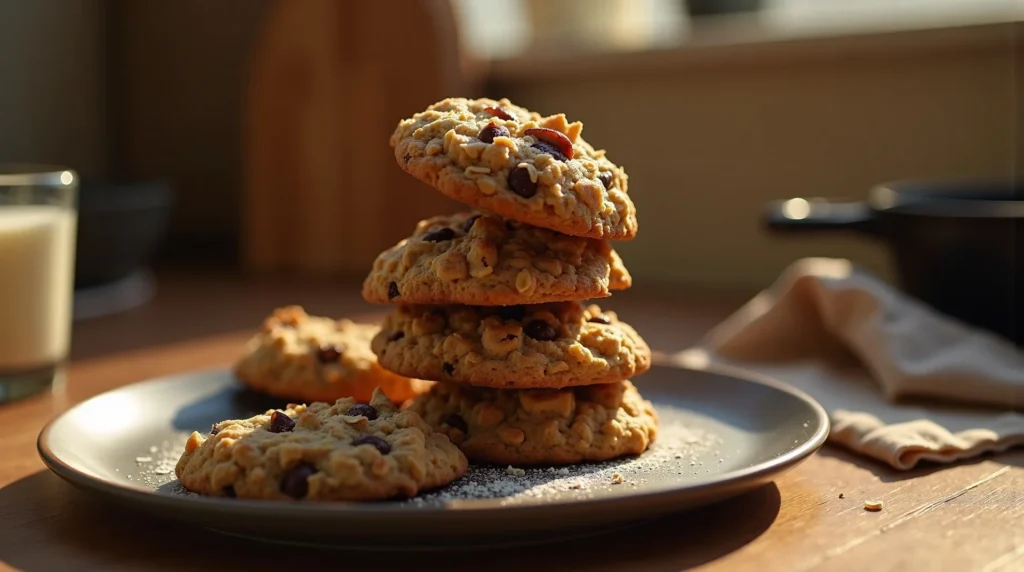
These legendary cookies use ten one-cup measures for massive yield and incredible texture—chewy, nutty, and loaded with chocolate. A true American classic!
Ingredients
The Base Ingredients (By the Cup)
Dry Structure & Leavening
The Texture Cups (Mix-ins)
Essential Tools
Stand mixer or large mixing bowl with hand mixer
Large rubber spatula
Two large baking sheets
Parchment paper or silicone mats
Standard cookie scoop (1.5 tbsp size)
Wire cooling rack
favorite You Might Also Love
Browse All arrow_forward
Traditional Spotted Dick Recipe: A Classic English Pudding
Mastering Flavorful Irish Coconut Date Bars at Home
The Easiest 4 Ingredient Lemon Cream Cheese Dump Cake Recipe

The Ultimate Halal Mexican Wedding Cakes Recipe
The Ultimate Heavenly Hash: A Creamy Retro Dessert Dream
Easy 5-Ingredient Sugar Cookie Cheesecake Bars
Preparation
Preparing the Foundation
Preheat your oven to 350°F (175°C) and ensure your racks are centered. Line your baking sheets thoroughly with parchment paper for easy release and even baking.
In the bowl of your stand mixer, vigorously cream together the 1 cup of softened butter, 1 cup of peanut butter, 1 cup of granulated sugar, and 1 cup of packed brown sugar until the mixture is visibly lightened and fluffy; this takes about 3 to 4 minutes on medium speed.
Beat in the 2 room-temperature eggs one at a time, mixing just until each egg is fully incorporated into the creamed base before adding the next. Scrape down the sides of the bowl completely.
Mixing the Structure and Flavor
In a separate bowl, whisk together the 1 cup of flour, 1 teaspoon of baking soda, and 1/2 teaspoon of baking powder until uniformly blended, ensuring the baking soda is thoroughly distributed.
Reduce the mixer speed to low and slowly add the dry mixture into the wet ingredients, mixing only until the last streaks of flour vanish; stop immediately to prevent overdeveloping the gluten.
Switch to a large rubber spatula and gently fold in the remaining four cups of ingredients: the oats, chocolate chips, coconut, pecans, and raisins. Use broad, sweeping motions until everything is evenly dispersed throughout the thick dough.
Baking for Perfection
Portion the dough using a standard cookie scoop (about 1.5 tablespoons) onto the prepared baking sheets, leaving a generous 3-inch space between each mound to allow for spread.
Bake the cookies one sheet at a time in the center of the 350°F (175°C) oven for 11 to 13 minutes. The edges should look set and golden, but the center should still appear slightly soft and puffy.
Allow the cookies to set on the hot baking sheet for a full 5 minutes before carefully transferring them to a wire rack to cool completely. This resting period is crucial for maintaining their chewy structure.
Recipe Variations
Spice Boost
Add 1 teaspoon of ground cinnamon and 1/4 teaspoon of ground nutmeg to the dry ingredients for warmth.
Tropical Twist
Substitute the pecans with macadamia nuts and use white chocolate chips instead of semi-sweet.
Gluten-Free Adaptation
Replace the 1 cup of all-purpose flour with a high-quality 1-to-1 gluten-free baking blend, ensuring the final texture remains chewy.
Chef's Tips
Always use creamy peanut butter here; natural, oily peanut butter can destabilize the creamed mixture and lead to a greasy cookie.
Ensure your brown sugar is properly packed into the measuring cup; too little brown sugar will result in a crispier cookie rather than the intended chew.
When scooping, if the dough sticks to the scoop, lightly spray the scoop with non-stick cooking spray between batches for cleaner release.
Do not try to bake more than one sheet at a time; uneven heat circulation is the enemy of perfectly baked 10 Cup Cookies.
Storage & Conservation
Airtight Container (Room Temp)
Store layered with parchment paper in a sealed container for up to 4 days for optimal chewiness.
Freezer (Unbaked Dough)
Freeze dough balls on a tray, then transfer to a freezer bag for up to 3 months; bake directly from frozen, adding 3-5 minutes to bake time.
Freezer (Baked Cookies)
Wrap tightly in plastic wrap, then foil, and freeze for up to 2 months; thaw on the counter or reheat briefly in a 300°F oven.
Common Mistakes
Overmixing the batter after adding the flour, which develops too much gluten and results in a tough, cake-like texture instead of a chewy one.
Using cold butter or eggs, which prevents the proper aeration during the creaming stage, leading to a dense, flat cookie.
Not allowing the cookies to cool on the baking sheet for the full 5 minutes, causing them to break apart when you try to move them prematurely.
Forgetting to account for the leavening power of baking soda; if you substitute baking powder for baking soda, the cookie will not spread correctly.
Recipe Keywords
Conclusion
There you have it, my friends: the definitive guide to creating spectacular 10 Cup Cookies. This recipe is a wonderful bridge between tradition and ease. It proves that the most satisfying desserts don’t require dozens of precise measurements or complicated techniques; they require quality ingredients and a confident hand. Embrace the simplicity of the cup measure, respect the creaming process, and pay attention to that magical duo of baking soda and baking powder. I encourage you to bake a huge batch of these chewy treasures this week. Share them, freeze them, or simply enjoy one warm with a cold glass of iced tea. When you master the 10 Cup Cookies, you master a piece of American baking heritage. Visit us again soon here at HomeRecipes.com for more iconic dishes made simple!
Frequently Asked Questions
How can I ensure my 10 Cup Cookies are chewy and not cakey? expand_more
Chewiness is the hallmark of a superb drop cookie. The primary culprits for cakey cookies are overmixing the flour (developing too much gluten) or using too much liquid/leavener. In this recipe, the balance of brown sugar to white sugar helps immensely, as brown sugar introduces moisture. However, the most critical step is to stop mixing the batter the second the flour disappears. Furthermore, underbaking slightly—pulling them when the centers still look a touch soft—ensures chewiness once they cool completely on the pan. Remember, the chemical reaction involving baking soda is key to achieving that spread and chew!
Is it necessary to use both baking soda and baking powder? expand_more
Yes, absolutely, and this is a common point of confusion for bakers moving beyond basic recipes. The baking soda reacts immediately with the acid in the brown sugar, giving you that initial spread and softening effect. The baking powder, being double-acting, provides a secondary, gentler lift in the oven, ensuring the cookie doesn't become overly flat and greasy due to the high volume of butter and mix-ins. Omitting either one will noticeably alter the final texture of your 10 Cup Cookies.
I don't like pecans or raisins. What are the best substitutions for the 10 Cup Cookies? expand_more
This is where you personalize your creation! For the 1 cup of pecans, feel free to substitute with walnuts, sliced almonds, or even crunchy toffee bits for a different flavor profile. If you dislike raisins, the best direct swap is dried cherries or dried cranberries; they offer a similar chew but with a brighter, tart flavor that cuts the sweetness. You could also increase the chocolate chips by one cup, making it a double-chocolate chip cookie, though it will be richer. Always ensure any dried fruit you use is relatively soft and plump.
Why did my cookies spread into one giant sheet instead of individual 10 Cup Cookies? expand_more
Cookie spread is usually caused by one of three things: the butter being too warm or melted, the dough not being chilled (if you choose to chill), or an imbalance in the dry-to-wet ratio. If your butter was oily when you creamed it, the dough structure failed before it even hit the oven. If you skipped chilling, the fats melted too quickly in the oven before the structure could set. Always aim for that 350°F (175°C) heat, which is hot enough to set the edges quickly. If you find your dough is always too soft, try chilling it for an hour before scooping.
What is the best way to store the raw dough if I want to bake later? expand_more
Raw dough for these 10 Cup Cookies freezes beautifully. Scoop the dough balls onto a parchment-lined baking sheet and place the entire sheet in the freezer until the dough is rock hard—about 2 hours. Then, transfer the frozen balls to a heavy-duty, labeled freezer bag. When you want to bake, simply preheat your oven to 350°F (175°C) and place the frozen dough balls directly onto the parchment-lined sheet. You will need to add about 3 to 5 minutes to the baking time, watching carefully until they are golden brown at the edges.